Does Villa Jovis Still Exist? What Is Actually Left
Planning the climb?Nothing about Villa Jovis sells out — the €6 ticket comes from a card-only machine at the entrance, and the site took 20,585 visitors in 2024 against 206,663 at the Blue Grotto. What you can lock in from home is a guide for the walk up, cancellable free up to 24 hours before.
Check tour availabilityWhat you walk past, in order
The Ministry’s own description follows the route, and so will I. You come in by the entrance ramps onto the viale dei mirti, through a vestibule, and into a tetrastyle atrium with cipollino marble columns — four columns, the green-veined marble from Euboea that the Romans used everywhere they wanted to look expensive. From there a mosaic corridor runs to the baths, with an apsed calidarium, and on to the living quarters. Servants’ rooms are to the west. Isolated at the north end, on the highest ground, is the emperor’s private residence, with its terrace and rooms floored in polychrome marble.
The cisterns are the building
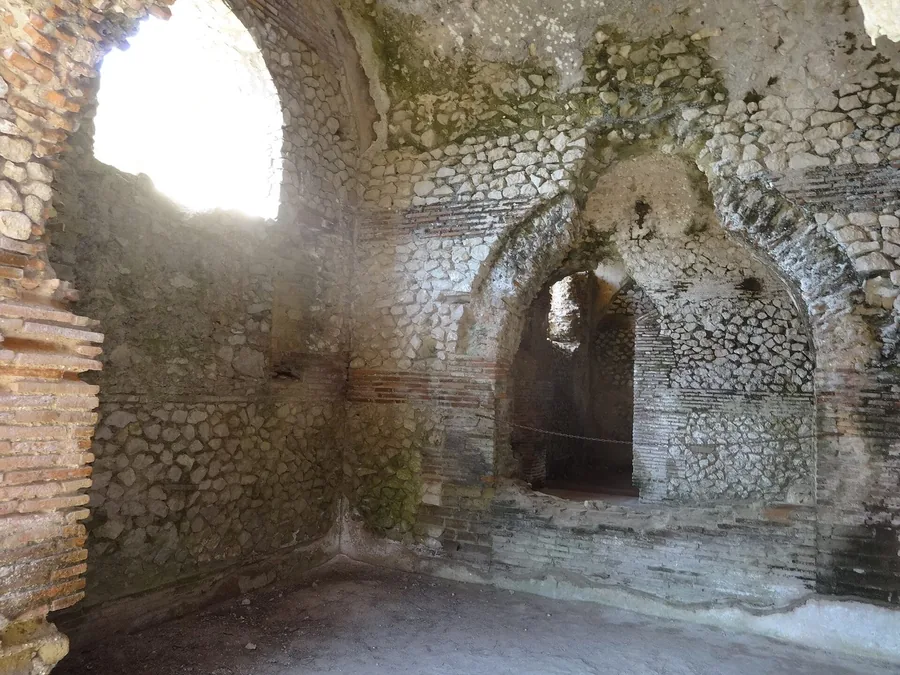
If you look at only one thing, look into the cisterns. Barrel-vaulted, sunk in the centre of the plan, they form the quadrilateral that everything else is built around — structurally and visually, they are the spine of the site. Most sources count four; the Ministry says only “a large quadrilateral with cisterns”, so treat the count as the usual figure rather than a certainty.
Here is why they matter. There is no spring on the summit of Monte Tiberio. Every drop of water on this hill was rain, caught off the roofs and stored. Drinking water, bath water, the lot. A man ran the Roman empire for a decade from a building whose first design problem was where to put the rain, and the answer is still up there with its vaults on. That is the engineering feat one reviewer, Sarah, said her guide helped her piece together, and she was right to be impressed by it.
The four wings
North, the imperial quarters. South, the administrative rooms. East, the reception rooms. West, the ambulatio — an open-walled belvedere walk along the edge, and the best place on the site to stand still. Italian sources widely give its length as 92 metres, but that figure is not officially confirmed, so call it about ninety metres or do not count it at all. From it you get the Bay of Naples, the Sorrentine peninsula and the Gulf of Salerno, and on a clear day Vesuvius, Monte Faito, Punta Campanella and Li Galli. Haze decides that more than the hour does.
The Faro, behind the ticket office
The quadrangular base of the Roman signal tower survives immediately to the right behind the ticket office, and most people walk past it without looking. Square below, cylindrical above; the tower itself came down in an earthquake. Suetonius, at Tiberius 74, records the Capreae lighthouse being thrown down by an earthquake as an omen around the time of the emperor’s death — popular retellings disagree about whether it fell days before or days after, so I leave the direction out. The Faro was restored and permanently lit in June 2026.
The chapel, the hermit and the Madonna that is not old
At the top stands the church of Santa Maria del Soccorso, built around 1610 and still intact. In the late 1800s a hermit lived there, kept a visitors’ book and sold wine to people who had just made the same climb you have.
Beside it, on a pillar, is the bronze Madonna, and this one needs saying plainly: it was installed in 1979. It was donated by the Caprese painter Guido Odierna (1913–1991) and replaced an earlier statue that lightning destroyed. Photographs of it circulate captioned as though it were ancient, or Baroque, or something Tiberius looked at. It is none of those. It is a good piece of 20th-century bronze in an extraordinary position, which is enough.
The honest summary
Roughly half the site stands at real height: the cisterns, the bath rooms, the imperial quarters, the terrace walls, the chapel. The rest is wall-stubs, floor lines and foundations, and in places the maintenance has clearly lapsed. The draw is as much the setting and the 334-metre panorama as the architecture, and anyone arriving expecting Pompeii will be disappointed within ten minutes. Anyone arriving expecting nothing will be surprised for an hour. That calculation is worked through on whether it is worth the walk.
Where the missing marble went
It did not simply decay. In the 18th century, under Charles of Bourbon and then Ferdinand IV, the Austrian Norbert Hadrawa was licensed to dig here, and the work was largely looting: marbles and sculptures stripped for royal palaces and for sale, finds scattered to European collectors and to what is now the Naples Archaeological Museum, with pieces reportedly reaching the Louvre and the British Museum. The marble floor of Capri’s cathedral of Santo Stefano came out of the imperial villa.
The modern excavation was Amedeo Maiuri’s, from 1932 to 1935, the first campaign running through the winter of 1932 to 1933. He described the site beforehand as formless rubble with the empty eye sockets of the vaulted cisterns emerging from it, and later called it the most exhilarating excavation of his career. It opened to the public in 1937. A restoration programme worth €4.9 million has run through the 2020s.
Since 2024 some of what Maiuri and his successors found is on show again at the Museo Archeologico di Capri, in the Prior’s Quarter of the Certosa di San Giacomo: about 120 objects across eight rooms, including Villa Jovis material that had been in storage or at the Naples museum. It sits on the €12 combined ticket described on tickets and prices, and it is the natural second half of this visit.
Give the cisterns ten minutes rather than thirty seconds. They are the one part of Villa Jovis that explains the whole building, and the one part nobody photographs. Who built it, and why up here, is on Tiberius on Capri.
Frequently asked questions
Does Villa Jovis still exist?
Yes. About 7,000 square metres survive, with eight levels of walls and staircases across several terraces, barrel-vaulted cisterns still roofed, bath rooms, the imperial quarters and a chapel of around 1610 at the summit. Roughly half the site is standing masonry at real height.
What can you see at Villa Jovis?
The entrance ramps and the viale dei mirti, a tetrastyle atrium with cipollino marble columns, a mosaic corridor, the baths with an apsed calidarium, the emperor’s quarters with polychrome marble floors, the ambulatio belvedere walk, the base of the Roman signal tower and the summit chapel. The panorama runs from Vesuvius to Li Galli on a clear day.
Is the Madonna statue at Villa Jovis Roman?
No. The bronze Madonna on her pillar at the summit was installed in 1979, donated by the Caprese painter Guido Odierna, replacing an earlier statue destroyed by lightning. It is modern, however often it is captioned otherwise.
Is Villa Jovis like Pompeii?
No. There are no standing houses and no painted rooms to walk through; this is terraced masonry, cisterns, floor lines and a view from 334 metres. Whether that is your kind of ruin is argued both ways on is it worth it.